
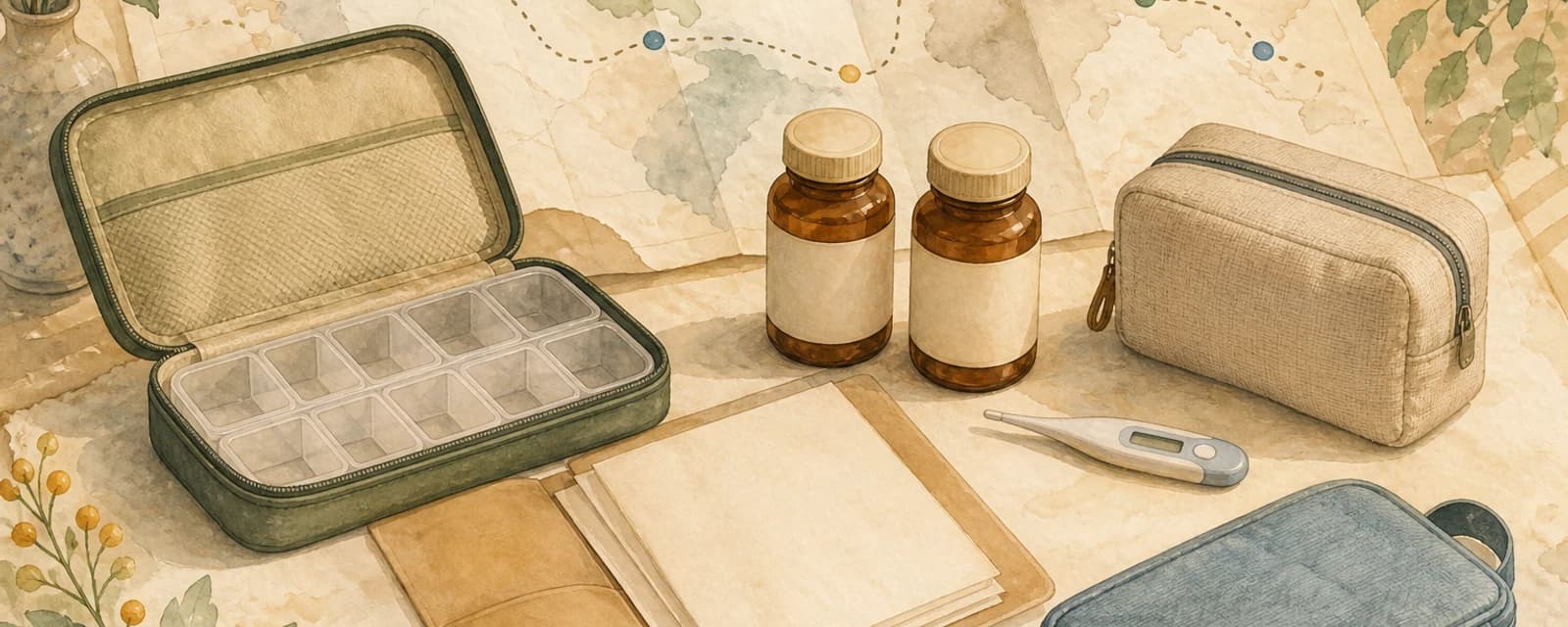
A medication plan for a long journey is more than a packing list. A medicine can be medically necessary yet require special evidence at a border, while transport, storage or replacement may work differently on a later leg. This article offers a leg-by-leg method for regularly prescribed medication. It does not provide dosing, treatment or legal advice and does not replace the prescribing clinician, pharmacist or current guidance from the responsible authorities.
Plan each medicine along the actual route
Do not begin by asking how much will fit into one suitcase for the entire journey. First create one row for each medicine and international leg: generic drug name, dosage form, prescribed strength, traveller, departure, transit, destination, dates and mode of travel. A brand name alone is not enough for cross-border planning because brands can change between countries.
The CDC notes that a transit country also matters when a traveller passes through customs there. A rule for the first destination is therefore not clearance for the next border. Keep the route as the structure for every later check.
Use four separate gates instead of one general approval
Break each leg into four questions. First: may this medicine, quantity and form pass through departure, transit and entry? Second: which prescription, letter, language, certification or permit is required? Third: will the medicine remain transportable through screening, carriage and the stay under its confirmed storage conditions? Fourth: will the lawfully carried supply last until a dependable next source of care and medication is available?
The gates can have different answers. A clinician's letter may support ownership but cannot replace a missing import permit. Carry-on access does not resolve an unknown temperature requirement. A larger supply does not help if the permitted import quantity is smaller.
- Gate 1: departure, transit and entry rules for substance, form and quantity
- Gate 2: person-linked prescription, letter and any required permit
- Gate 3: security screening, transport and confirmed storage conditions
- Gate 4: supply, delay margin and a dependable resupply path
Check controlled or restricted substances country by country
The International Narcotics Control Board collects rules submitted by governments for travellers carrying internationally controlled substances. It is a useful starting point, not a substitute for the country's currently responsible authority. Countries can control additional substances, allow different quantities or require their own documents.
Use official country, customs, health or embassy sources for every leg and record the responsible contact. Germany's Federal Ministry of Health, for example, describes particular documents for certain controlled medicines within the Schengen area and different procedures outside it. The UK government gives its own evidence and quantity rules for entry. These examples show precisely why no number or form should be treated as worldwide.
Build the evidence around the person, generic name and route
WHO and CDC guidance recommends a clinician's letter and prescription copies for certain prescribed medicines. As confirmed for the relevant country, the evidence should connect the traveller to the medicine and may need the generic name, strength, dosing details, required quantity, travel dates and medical need. The responsible authority decides which language or official confirmation is sufficient.
Keep original containers and labels as required by the authorities and advised by the pharmacist. Do not move tablets into unlabelled containers for convenience if that removes identity or storage information. Store a protected replacement copy separately, but do not assume it will be accepted as an original.
Have transport and storage conditions confirmed professionally
Temperature, light, humidity, freezing and the acceptable time outside controlled conditions are product-specific. Do not derive a cooling method from a general travel article. Ask the prescribing clinician or pharmacist for the manufacturer's instructions for the actual product and for guidance on transport, temporary storage and what to do after a possible temperature excursion.
At EU aviation security checkpoints, essential liquid medicines may be carried in the quantity needed for the journey above the general 100-millilitre limit, although proof of authenticity can be requested. This is a screening rule, not a statement about airline, customs, dangerous-goods or import requirements. Review those boundaries separately for the actual service.
Plan supply and replacement without assuming postal delivery
WHO and CDC guidance recommends sufficient supplies for foreseeable needs and possible travel delays. The appropriate amount must still match the prescription, expiry, insurance position and every border's rules. Carrying more is not automatically the safer answer.
Do not treat a local purchase or parcel from home as an unverified fallback. Medicines can have different names or formulations, be unavailable locally, or face separate postal-import rules. If the journey lasts longer than the lawful or available supply, the relevant leg needs a concrete, clinically and legally checked resupply route before departure.
Keep children's medicines and measuring devices separate from adult plans
The CDC stresses that a travel health kit should fit the traveller, duration, itinerary and health needs, and refers to age-appropriate products and measuring devices for children. That does not establish a general dose. Carry only the current individual treatment plan and its matching measuring or administration device.
Where several people travel, record clearly who each medicine belongs to, who manages it day to day and where the confirmed information can be found. Do not rely on colour alone. The traveller's name, generic drug name and prescription should remain understandable if a pouch or outer container is replaced.
Worked scenario: a connection, heat and another border
A family flies with a child's regularly required, temperature-sensitive medicine from Country A through Country B to Country C. Three weeks later they plan to continue overland to Country D. The prescription copy and insulated pouch are ready for the first flight, but transit in B, the permitted quantity for D and supply after week four remain unresolved.
The family does not release the whole journey. For A–B–C, they check the substance and quantity with the responsible authorities, have the evidence and transport conditions confirmed, and document screening and accommodation storage. C–D gets a separate row. Until the import rule and resupply path are clear, that leg is changed or not booked. The medicine is never carried across a border as a test.
Keep a small, versioned medication file
A useful working file separates changing rules from medical records. The leg matrix contains the source, authority, review date, answer and next review point. Prescriptions and letters stay protected with the person who needs them. Diagnoses and full medical records do not belong in a public trip plan, open group chat or unprotected note.
Recheck the affected row after any change to the medicine, strength, quantity, route, transit, date, carrier or storage method. Deliberately remove superseded printouts so that two contradictory versions do not remain in the carry-on bag.
Decision rule: four green gates for every leg
A leg is medication-ready only when all four gates are answered by a current official or professionally responsible source and the documents match the actual route. A blank country row, unanswered authority query, unconfirmed cooling assumption or vague local-purchase plan remains open.
Perform a currency check shortly before departure and review again after changes. The four-gate rule cannot guarantee entry or medical care. It prevents a medically necessary treatment from depending on an unchecked border, transport or supply assumption.