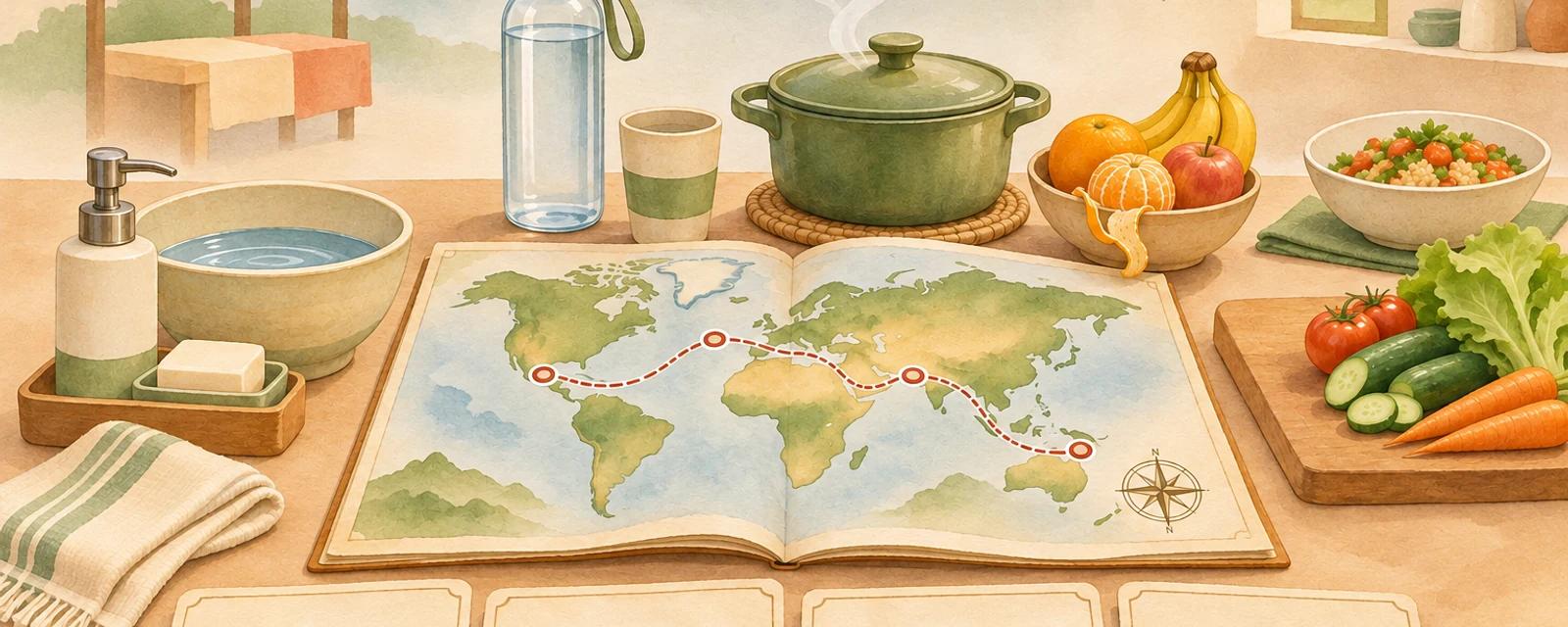
A tap, bottle or warm meal alone does not prove that a family’s supply is safe. Water quality, preparation, refrigeration and reliable information can change from one stage of a long journey to the next. This working method organises decisions about drinking, brushing teeth, ice, food and hand hygiene. It can reduce risk, but cannot guarantee that nobody becomes ill and does not replace current official advice or individual travel-health guidance.
The planning problem: one accommodation has several water paths
“Can we drink the tap water?” is too narrow a question. The same source may matter for drinking, brushing teeth, ice, washing produce, cooking, washing eating utensils or preparing infant formula. One missed use can therefore break an otherwise careful plan.
CDC notes that water can contain pathogens or chemical contaminants where treatment is inadequate or uncertain. Appearance, smell and experience from an earlier trip are not current evidence for the next journey leg.
Create a separate review row for every journey leg
Divide the route at every new accommodation, transit and material supply change. Record the arrival date, place, authority responsible for water information, most recent check and prepared fallback. An airport hotel, an apartment and a rural day trip may need three different answers.
Use current information from local authorities, the accommodation and official travel or health bodies. Country-wide lists are too coarse: disruption, building plumbing or a natural event can change the answer within the same place.
- Leg and date
- current official or local information
- water source for every practical use
- food and hand hygiene
- fallback and next review time
Cover every use, not only the drinking glass
For each leg, state which water will be used for drinking, brushing teeth, cooking, making ice, washing fruit and vegetables, and cleaning eating utensils. If one use is unresolved, the water field remains amber.
CDC and the German Federal Foreign Office recommend a dependable alternative, such as water from an unopened factory-sealed container or water that has been treated appropriately, when the source is uncertain. Ice belongs in the same review as the drink; a cold glass does not reveal where the ice came from.
Choose the water source before the treatment method
The strongest option is a currently confirmed safe source. Where that cannot be established, decide before arrival whether sealed water is available or which documented treatment fits the actual hazard and water quality.
No single method is automatically suitable for every contaminant. CDC expressly warns that cloudy or discoloured water can involve chemical contamination and is not automatically made safe by boiling or disinfection. In that situation, the family needs another source and follows local instructions.
Treat food as a chain of five decisions
WHO summarises safer food handling in five steps: keep clean, separate raw and cooked food, cook thoroughly, keep food at safe temperatures, and use safe water and raw materials. For a journey leg, that becomes a chain rather than a hunch.
Do not review only the finished dish. The water used for washing, contact between raw and cooked ingredients, sufficiently hot service, dependable refrigeration, and clean hands and surfaces all matter.
Observe temperature and preparation when eating out
Fresh, fully cooked food served hot is usually the more dependable choice where hygiene conditions are uncertain. Lukewarm dishes, buffets without reliable temperature control, raw animal products, unpasteurised products, and pre-cut raw fruit or vegetables need particular caution.
This is not a judgement about a cuisine or culture. The same rule applies in a hotel, restaurant, market, aircraft and the family’s own apartment. If preparation or temperature cannot be assessed, choose an option that is easier to verify.
Put hand hygiene where decisions actually happen
Handwashing with soap and suitable water belongs before food preparation and eating and after using the toilet or changing a nappy. Younger children need practical supervision; a note on a list does not wash hands.
CDC identifies alcohol-based hand sanitiser containing at least 60% alcohol as an alternative when soap and water are not readily available. It does not resolve an uncertain food or water source and does not replace physical cleaning of visibly dirty hands.
Give infant feeding and additional risks their own row
Infants, young children, pregnant people, older adults and immunocompromised people can be more susceptible. For infant formula, the water source, product instructions, clean preparation, storage and disposal need to be resolved together; one general family row is not enough.
CDC identifies sterile ready-to-feed formula as one possible option and describes additional precautions for powder. The suitable choice for a particular child belongs with a paediatrician or travel-health clinician and the manufacturer’s instructions before departure. This article gives no individual feeding or treatment advice.
Worked scenario: a late arrival at an apartment
A family arrives in the evening. The host says only that the water is “normally” drunk, while current municipal information is not yet reachable. The family does not treat that statement as clearance: it uses unopened sealed water for drinking and brushing teeth, skips ice and unwashed raw produce, and prepares a simple meal that is fully cooked and served hot.
The next morning, one adult checks the current local notice and asks the host specifically about the building supply and any disruption. Only a dependable answer changes the task row. If the question remains open, the prepared fallback stays in use; convenience does not become evidence.
The decision rule: five green fields for every leg
A leg becomes green only when five points have concrete answers: current water source, complete coverage of all water uses, an understandable food-handling chain, reachable hand hygiene, and a practical fallback with a new review time. An assumption or old trip report remains amber.
Red means that a necessary use has no dependable water source, a local warning would be ignored, or a more susceptible person would depend on unresolved preparation. Change the supply before the meal or use takes place.
Precautions reduce risk; they do not promise safety
CDC stresses that travellers cannot control every hygiene factor and that food and water precautions do not eliminate illness risk. Record the strongest currently supported decision and a simple route to switch, not a guarantee.
For diarrhoea, vomiting, fever, signs of dehydration or unusually severe symptoms, use current local medical help and individual professional advice. Especially for young children or existing conditions, the threshold for care should not be inferred from a general blog article.
Restart the review after every relevant change
A new accommodation, local warning, supply disruption, flood, changed water colour, loss of refrigeration, different food source or new health situation resets the affected fields. A sound decision yesterday does not prove the situation after a change.
Keep the recheck short: read the source, mark the affected uses, activate the fallback and record the next review time. More data is useful only when it improves the next concrete decision.