
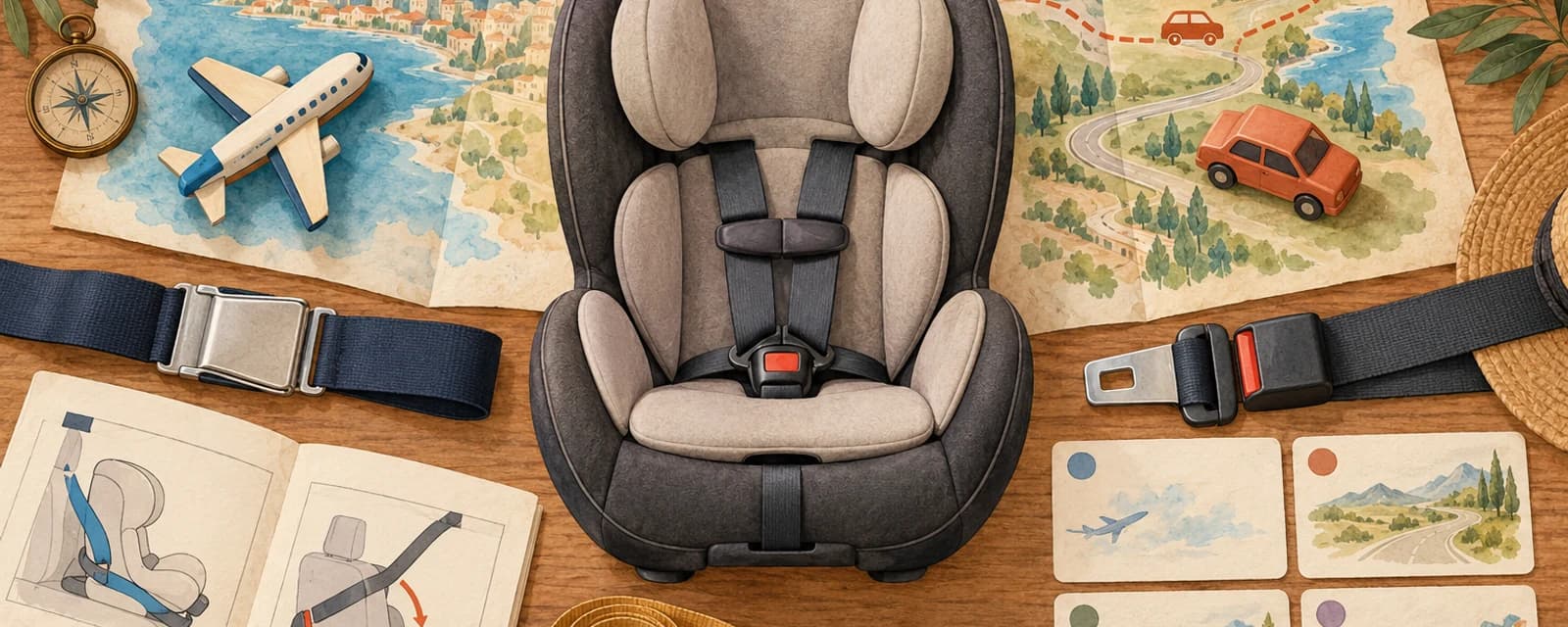
A child seat can be suitable for a car yet not approved or installable on an aircraft. An aviation-only restraint can be useless on the road. This method links the child, device, operating carrier, actual seat, vehicle and local rules in one journey-leg matrix. It is not legal, product or individual safety advice; current authority rules, carrier conditions and both the restraint and vehicle instructions remain decisive.
The planning problem: one piece of luggage, several safety boundaries
A long family journey changes more than countries. It can move through a feeder car, flight, connection, taxi, rental car or minibus, each with different approvals, belts, anchors, seat positions and exceptions. Saying “we will take our car seat” therefore does not yet answer the safety question.
The FAA, EASA, Transport Canada and CASA expressly distinguish motor-vehicle approval from suitability for an aircraft seat. Road rules also vary by country and vehicle type. Treat the restraint as a chain of separate clearances rather than a one-time packing choice.
Start with one row for every child and actual journey leg
Record each child separately with current age, height, weight and the limits of the proposed system. Then split the route whenever the vehicle or responsible operator changes. A codeshare operated by two airlines needs two rows; an airport transfer and a later rental car do as well.
Each row needs the transport mode, date, operating carrier or vehicle type, country or jurisdiction, intended seat position, belt or anchor type, proposed restraint and evidence. Without that mapping, a general approval label cannot show whether the actual installation works.
- Child: age, height, weight and any additional support need
- Leg: operator, aircraft or vehicle, seat position and jurisdiction
- System: mode, approval marking, limits and installation instructions
- Evidence: current rule, written carrier answer or vehicle confirmation
Track 1: Does the system fit the child now?
Begin with the permitted use range, not the route. Age alone is not enough: manufacturer limits can combine height, weight, orientation, harness mode and developmental readiness. On a combination seat, the same shell may be treated differently with its internal harness fitted and in booster mode.
For boosters, NHTSA explains that the lap-and-shoulder belt must sit correctly across the hips and chest and that the child must be ready to stay properly positioned. Do not present this U.S. guidance as worldwide law; use it as a clear example of why a height or age figure without an actual belt-and-seat fit is not a reliable clearance.
Track 2: Is this exact mode approved for the transport type?
Find the approval marking physically attached to the system and compare it with the current authority rule. For a conventional child restraint on a U.S. aircraft, the FAA requires the relevant aircraft certification or a recognised foreign-government marking. Boosters, baby carriers and backless restraints cannot be used there as the aircraft restraint during surface movement, take-off or landing.
An aviation harness is not automatically a road restraint. The FAA describes the approved CARES device as aircraft-only. In the other direction, Transport Canada explains that a combination seat can qualify on an aircraft when the internal harness is fitted and the labels match, but not when used in booster mode. Check the mode, not merely the product name.
Track 3: Does the operating carrier accept the system and installation?
EASA recommends checking aircraft approval, dimensions, securing method and manufacturer instructions with the airline in advance. The operating carrier for each leg matters, not only the brand on the booking confirmation. A codeshare, connection or operator change can therefore change the answer.
Ask about the exact restraint model and approval label, forward- or rear-facing installation, permitted seat position, seat width, restricted rows, the need for the child's own ticketed seat and what happens after an aircraft change. Carry the instructions. A generic chat reply that “child seats are allowed” remains amber if it does not cover the proposed mode and leg.
Track 4: Does the system fit the actual road vehicle?
For a rental car, private transfer or taxi, “child seat available” is not enough. Confirm vehicle class, seat direction, lap or three-point belt, ISOFIX anchors, head restraint, airbag and the number of systems that must fit together. NHTSA's booster guidance includes a flat seat fit, an appropriate lap-and-shoulder belt and, for backless boosters, a suitable head restraint or high seat back.
The vehicle manual and restraint instructions must agree. An ISOFIX promise is irrelevant if your system or the selected seating position uses another installation. A vehicle category is also not an exact-model guarantee. If the vehicle stays unknown until collection, prepare a controllable alternative rather than improvising at the kerb.
Track 5: Which road rule applies here and in this vehicle?
The European Commission notes that national road rules vary even though children generally need appropriate restraints. Check departure, transit and destination, plus every planned vehicle type, with the responsible authority. Do not assume that the rule from home travels with you.
GOV.UK shows how specific a national rule can be: its requirements depend on factors including age, height, approved seat, belt or ISOFIX, front airbag and seating direction. That is an example, not a worldwide template. Taxi, bus or short-notice exceptions are also not a recommendation for the safest available solution and must not be carried into another jurisdiction.
Seat location and family seating form a separate gate
An approved system does not automatically solve seat location. EASA describes a window seat as preferred so the restraint does not obstruct an evacuation path and excludes certain exit-row areas. The FAA also points to carrier-specific safe locations. Review the device and seat assignment together.
Placement of accompanying adults remains separate too. The U.S. Department of Transportation publishes conditional fee-free family-seating commitments for selected U.S. airlines; conditions include the same reservation, seat availability and possible aircraft substitution. That dashboard is not a global promise. Record the actual seat assignment and recheck it after every equipment or schedule change.
Worked scenario: two children, two flights, a taxi and a rental car
A family travels with a toddler using an internal harness and an older child who uses a booster on the road. Carrier A operates the first flight and Carrier B the connection. A pre-booked taxi follows, then a rental car three days later in another country. One row saying “two child seats packed” would conceal four different decisions.
The family checks the harnessed seat against both aircraft and carriers, reserves suitable seats and saves the instructions. The booster is not planned as an aircraft restraint; it is used only in confirmed road vehicles with the required three-point belt and seat-back or head-restraint configuration. Taxi and rental-car rules, exact vehicle or credible equipment confirmation, and a fallback are documented separately. If a critical row remains open, the family does not proceed on the basis of an assumed exception.
Prepare a safe alternative for every leg
A fallback is not “any seat available locally”. It names a pre-checked alternative: another confirmed vehicle, another approved system, another seat position, a delayed leg or a transport mode that removes the unresolved boundary. The alternative must pass the same five tracks as the primary plan.
Define the stop point too. If the carried system is rejected at the gate, or the belt, anchor or seat geometry does not fit at vehicle collection, use the prepared alternative instead of deciding under time pressure. Checking the restraint as baggage or taking an unprotected ride is not an equivalent fallback.
The decision rule: five evidenced yes answers per child and leg
A leg becomes green only when five questions have evidenced yes answers: Does the system fit the child? Is the chosen mode approved for this transport type? Does the operating carrier or operator accept it? Does the installation fit the actual seat or vehicle? Does the solution meet the current local rule?
Amber means unclear, oral-only or overly broad evidence; red means prohibited, not installable or not resolvable in time. Amber and red do not release the leg. A change in child, system mode, carrier, aircraft, seat assignment, vehicle, belt, country or rule starts a fresh review for the affected row.
Keep a small evidence pack available offline
Store photos of approval labels, the relevant manufacturer-instruction pages, written carrier answers, seat or vehicle confirmation and the dated authority source. Both responsible adults should be able to reach the evidence without the main phone. Private details about children do not belong in a public trip plan or article.
Before each leg, confirm that child measurements, device, operator and vehicle still match. Growth, a mode change, replacement restraint, aircraft substitution, vehicle substitution or rule change makes the earlier evidence insufficient on its own. The matrix remains a working method rather than a filed and gradually obsolete checklist.